
Understanding the code
Cal/OSHA tie-back rules, without the legalese.
California's exterior building maintenance rules are the strictest in the country. Here's what Title 8 actually requires on the roof, and what it means for your next wood-framed building.
When are roof tie-backs required?
Title 8 §3291(f)(1) is the rule that matters:
"Every building constructed 3 stories or 36 feet or more in height, shall have roof tie-backs or other permanent devices installed at the roof level for the purpose of securing or tying back suspended scaffold hooks or clamps and safety lines."
Three stories or 36 feet. Hit either one and you need them. Hardy measures the 36 feet from the top of the parapet. And §3291(f)(3) closes the loop: suspended scaffolds aren't permitted at all unless roof tie-backs or equivalent anchorages are provided.
What are the exceptions?
- Another permanent system. Tie-backs aren't required if the building uses another acceptable permanently installed rooftop maintenance system under Article 5 or Article 6.
- Up to 4 stories or 48 feet, when building maintenance can be done with extension tools, ladders, approved ground equipment such as scaffolds, or aerial devices designed for positioning personnel.
Exception 2 is where projects get burned. If the site won't let a lift reach every wall, the exception doesn't apply. Find out before framing, not after.
How far apart, and how strong?
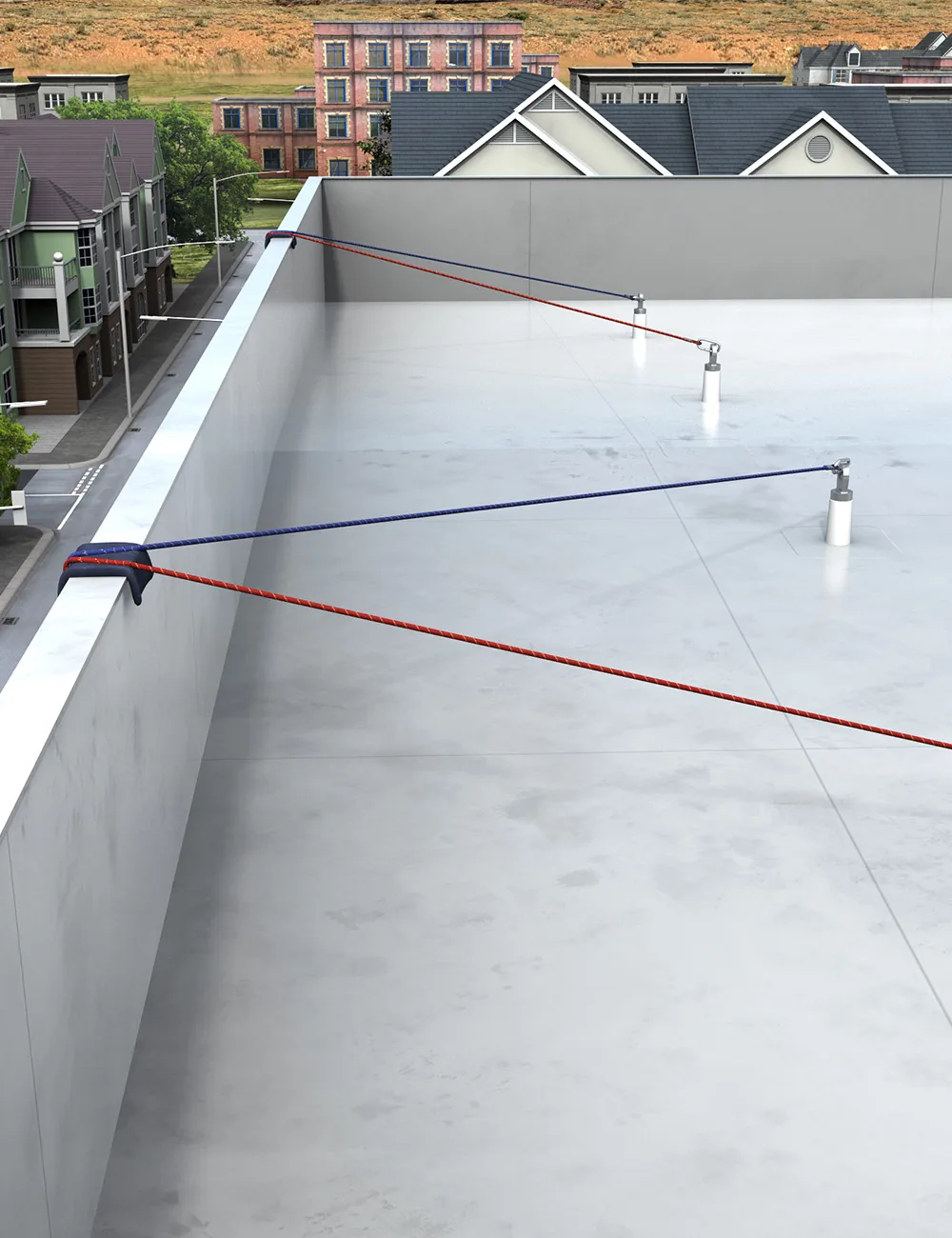
Under §3291(f)(2), tie-backs go at approximately 12-foot intervals. Spacing depends mostly on where the roof has framing members strong enough to carry the loads. They can go in structural parapets of adequate strength, placed as close to roof level as practicable. Every tie-back must meet three design criteria:
| Criterion | Requirement | Hardy |
|---|---|---|
| (A) Eye | At least a 2-inch inside diameter closed eye | Closed-eye tie-back devices |
| (B) Corrosion | Hot-dip galvanized or equivalent corrosion resistance | Fully galvanized |
| (C) Load | Assembly and anchorage sustain 5,000 lb in any direction without permanent deformation | 5,000 lb, no additional engineering |
Do buildings under 36 feet need fall protection?
Yes, when workers routinely come within 6 feet of a fall hazard. Routine means four or more times a year. A fall hazard is an elevation difference of 30 inches or more. A parapet or guardrail 42 inches or higher is passive fall protection and meets the requirement. Under 42 inches, a routine-maintenance fall protection system has to be designed.
Do you need an EBM design and an OPOS?
Ask one question: will the windows be washed? If yes, that's scheduled maintenance. Window-washing companies must follow an Operating Procedure Outline Sheet (OPOS), which requires an exterior building maintenance (EBM) design by a Scaffold, Inspection and Testing (SIT) company. Window-washing companies can be fined if no OPOS is provided.
You don't need the EBM design or OPOS to get the building permit. You need it before scheduled maintenance. If there's no scheduled maintenance, tie-backs are still required at about 12 feet on center, and painting or repair crews will need an OPOS later. Getting it later risks having to alter the fall protection system, and that cost can be significant. More on OPOS and EBM design.
Is load testing required?
Yes. Title 8 §3296 requires every completed building maintenance installation to be inspected and tested in the field before initial service. Roof tie-backs are tested to no more than 50% of rated capacity: a 5,000 lb tie-back is never tested past 2,500 lb. Hardy includes this testing in California through the independent agency Specialized Testing, Inc. How the field test works.
What is the ER-461 code report?
An evaluation report tells the building official a product has been through third-party scrutiny. Hardy's IAPMO Uniform Evaluation Service report ER-461 covers the Hardy Tie Back Devices, Hardy Tie Back Saddles and Hardy Outrigger Systems for use as roof-level tie-back systems and scaffolding supports, with California and City of Los Angeles supplements, and is backed by IAPMO's continuous compliance inspection program. Why that report matters.
Code documents
Read the source.
Frequently asked questions
When are roof tie-backs required?
Under California Code of Regulations Title 8 §3291, every building 3 stories or 36 feet or more in height must have roof tie-backs or other permanent devices at roof level to secure suspended scaffold hooks, clamps and safety lines. Exceptions apply to buildings using other approved permanent rooftop maintenance systems, and to buildings up to 4 stories or 48 feet when maintenance can be done with extension tools, ladders, approved ground equipment or aerial devices.
Do buildings under 36 feet need fall protection anchors?
Yes, when workers routinely approach within 6 feet of a fall hazard. Routine means four or more times a year, and a fall hazard is an elevation difference of 30 inches or more. A parapet or guardrail 42 inches or higher counts as passive fall protection; below 42 inches, a routine-maintenance fall protection system must be designed.
How far apart should tie-backs be spaced?
Approximately 12-foot intervals, depending on the availability of roof framing members strong enough to carry the loads (Title 8 §3291(f)(2)). Tie-backs may go in structural parapets of adequate strength, as close to roof level as practicable.
Does the building need an EBM design?
If the windows will be washed, that's scheduled maintenance, and window-washing companies must follow an Operating Procedure Outline Sheet (OPOS), which requires an exterior building maintenance (EBM) design by a Scaffold, Inspection and Testing (SIT) company. The EBM design and OPOS aren't needed for the building permit, but are required before scheduled maintenance. Without scheduled maintenance, tie-backs are still required at about 12 ft on center.
Who installs the anchors?
Usually the framer. Unless the project spec says otherwise (very rare), the contractor can install fall protection anchors. Hardy recommends the framer install the Saddle on the ground before the beams or trusses go up. It's safer and faster.
Is load testing required?
Yes. Title 8 §3296 requires completed installations to be inspected and tested in the field before initial service. Roof tie-backs are tested to no more than 50% of rated capacity: a 5,000 lb tie-back is tested to no more than 2,500 lb. Hardy includes load testing by the independent agency Specialized Testing.